What ludo game Is and How It Works, Rummy Ludo
How what ludo game is and how it works works for ludo game, UPI details, realistic timings and the pitfalls to avoid.
What is Ludo Game and How It Works?
The ludo game is one of the most beloved board games in the world, and its roots run especially deep across India. Derived from the ancient Indian game of Pachisi, ludo has evolved from a royal pastime played in Mughal courts into a modern, fast-paced skill and strategy game enjoyed by millions of players online and offline every single day. Understanding how the game works is the first step toward mastering it.
At its core, the ludo game is a race game for two to four players. Each player controls a set of four tokens, also called pieces or pawns, and the goal is straightforward: move all four of your tokens from the starting yard, around the cross-shaped board, and safely into the home column before your opponents do. Movement is determined by rolling a six-sided die, which introduces an element of chance, but smart decision-making, tactical blocking, and knowing when to take risks are what separate average players from truly skilled ones.
The Board Layout Explained
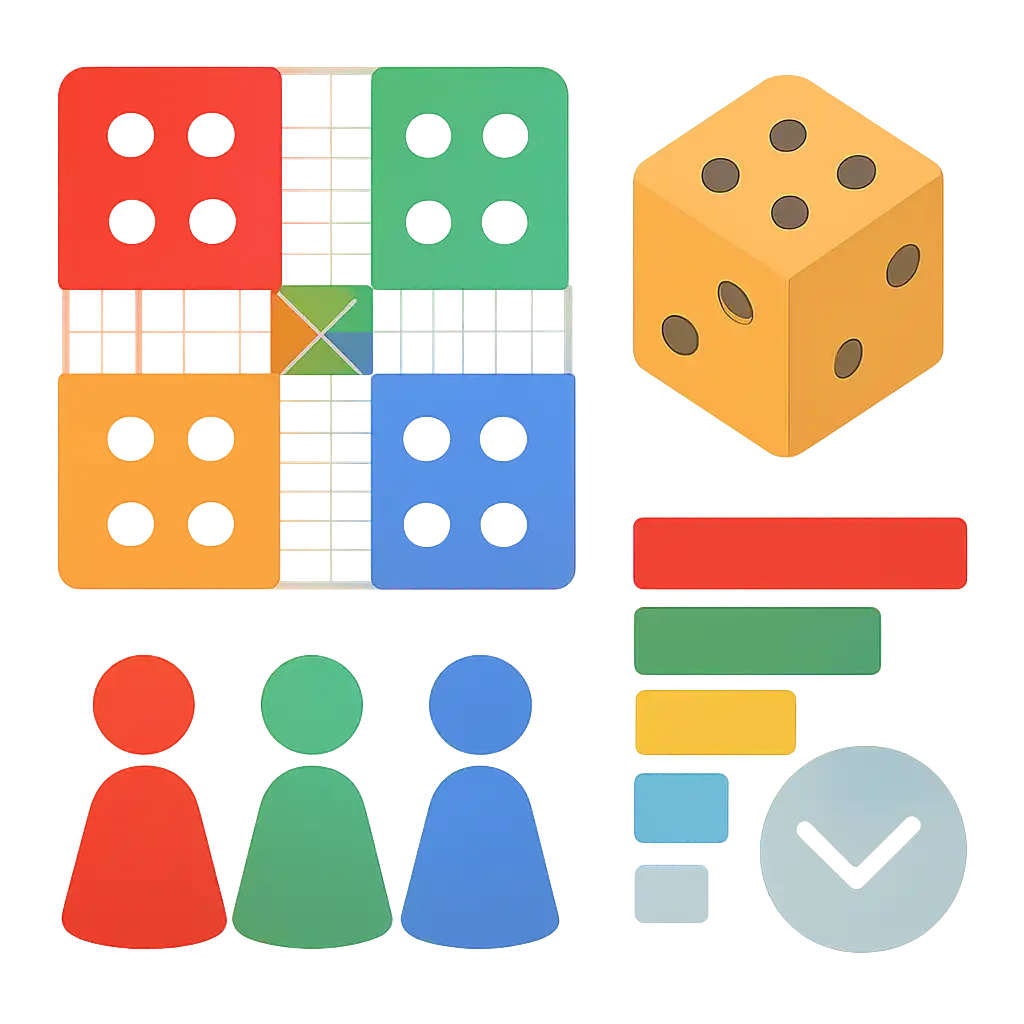
The ludo board is a square grid divided into a distinctive cross shape. Each of the four arms of the cross represents a colour zone, typically red, green, yellow, and blue. The key areas of the board include:
- Home Yard (Starting Area): The coloured circle at each corner of the board where your four tokens begin the game. Tokens in the yard are safe from capture.
- Starting Square: The first square on the main track, where a token enters the board after rolling a six.
- Main Track: The shared outer loop of 52 squares that all players navigate simultaneously. This is where captures and strategic blocking happen.
- Safe Squares: Certain marked squares on the board, usually indicated by a star or special colour, where tokens cannot be captured by opponents.
- Home Column: The coloured column that leads from the main track into the centre. Only your own tokens can travel along your home column.
- Home Triangle (Centre): The final destination for all four of your tokens. Reaching here with all four tokens wins you the game.

The Tokens and Their Colours
In a standard ludo game, each player is assigned a colour and receives four tokens of that colour. All tokens start locked in the home yard and must be unlocked by rolling a six before they can begin their journey around the board. This rule alone creates an exciting dynamic right from the very first turn, the urgency to roll a six and unleash your tokens onto the track is a tension every ludo player knows well.
How Ludo Differs from Pure Luck Games
A common misconception is that ludo is purely a dice game driven by luck. While the dice roll does introduce randomness, experienced players consistently outperform beginners because of strategic choices: which token to move when multiple options are available, when to chase an opponent's token versus advancing your own, how to use the safe squares intelligently, and how to time your moves to create blockades. These decisions make ludo a game of genuine skill, which is why competitive online ludo platforms like Rummy Ludo have flourished in India.
Ludo Game Step-by-Step Guide
If you are new to the ludo game or want to brush up on the official rules before joining a real-money table on Rummy Ludo, this complete step-by-step guide covers everything from the initial setup to claiming your win. Follow each step carefully and you will be ready to play with confidence.
Setting Up the Game
- Choose your colour. Each of the two to four players selects a colour, red, green, yellow, or blue. In a two-player game, players typically choose opposite corners of the board for a balanced start.
- Place your tokens in the home yard. All four of your tokens begin the game inside the circular home yard in your colour's corner. They are locked here until you roll a six.
- Decide the turn order. Each player rolls the die once. The player who rolls the highest number takes the first turn. Play then proceeds in a clockwise direction around the board.
- Prepare the board. In online ludo on platforms like Rummy Ludo, the board is automatically set up for you. In physical play, simply unfold the board and verify all 52 main track squares are visible and unobstructed.
Taking Your Turn
- Roll the die. On your turn, roll the six-sided die. The number you roll determines how many squares you may move one of your tokens.
- Roll a six to unlock a token. If all of your tokens are still in the home yard, you must roll a six to bring one token onto the board, placing it on your colour's starting square. Rolling a six also earns you a bonus turn, you get to roll again immediately.
- Choose which token to move. Once you have one or more tokens on the board, you can choose which token to advance by the number shown on the die. This is one of the most strategically important decisions in every turn. Consider the position of opponent tokens, available safe squares, and how close each of your tokens is to the home column.
- Move your token the exact number of squares. Count out the squares in a clockwise direction along the main track. You must move exactly the number shown, you cannot move fewer squares or split a roll between two tokens.
- Capture an opponent's token (optional). If your token lands on a square occupied by an opponent's token, that opponent's token is sent back to their home yard and must restart its journey. The capturing player earns a bonus roll of the die. Note: you cannot capture a token sitting on a safe square or in a blockade (two same-colour tokens on one square).
- Form a blockade. If two of your own tokens occupy the same square, they form a blockade. No opponent token can pass through or land on a blockade square. This is a powerful defensive and offensive tactic.
- Enter the home column. Once a token has completed the full loop of the main track (52 squares), it turns into your coloured home column. Tokens in the home column are completely safe from capture.
- Move tokens into the home triangle. From the home column, advance your tokens one square at a time until they reach the very centre of the board, the home triangle. You must roll the exact number needed to enter home; you cannot overshoot. For example, if a token is three squares away from home, you must roll a three to bring it in.
- Win the game. The first player to successfully move all four of their tokens into the home triangle wins the game. On Rummy Ludo, winning a cash game awards you the prize pool based on the table stakes you selected when joining.
Special Rules to Remember
- Rolling a six always grants a bonus roll, regardless of what action you use the six for.
- If you roll three consecutive sixes, the third six is cancelled and your turn ends with no move.
- If you have no valid move, for instance, all tokens are in the yard and you did not roll a six, your turn passes to the next player.
- In timed online games on Rummy Ludo, each player has a set amount of time per turn; if the timer runs out, the platform automatically selects a move or passes the turn.
Ludo Game Safety, Fees, and Timing
Before joining any online ludo game for real money, it is essential to understand the platform's safety credentials, how fees are structured, and what the typical game duration looks like. Rummy Ludo is designed with transparency and player security at the forefront, but knowing these details empowers you to play responsibly and make the most of your experience.
Is Playing Ludo Online Safe?
Safety is the number-one concern for any player considering an online gaming platform. Rummy Ludo addresses this across several layers:
- Secure Transactions: All deposits and withdrawals on Rummy Ludo are processed through encrypted payment gateways. Your financial data is never stored in plain text on the platform's servers.
- KYC Verification: Before withdrawing winnings, players complete a Know Your Customer (KYC) process. This protects the community by confirming the identity of all participants and preventing fraudulent accounts.
- Fair Play Guarantee: The random number generator (RNG) that determines dice rolls in the online ludo game is certified by independent auditors. This ensures every roll is truly random and not influenced by the platform or other players.
- Responsible Gaming Tools: Players can set daily deposit limits, self-exclude temporarily or permanently, and access support resources. Rummy Ludo encourages players to treat gaming as entertainment, not as a financial strategy.
- Legal Compliance: Skill-based online gaming is legal in most Indian states. Rummy Ludo operates in compliance with applicable laws and makes it clear which states are excluded from real-money play due to local regulations.
Understanding Platform Fees
Like all competitive online gaming platforms, Rummy Ludo charges a platform fee, commonly called a "rake" or "commission", which is how the platform sustains its operations. Here is what you need to know:
- Entry Fee: Each cash table requires an entry fee, which is the amount you pay to join a game. Tables are available at a wide range of stakes, from low-entry practice tables to high-stakes tournaments.
- Platform Commission: A percentage of the prize pool, typically between 10% and 20% depending on the table type, is retained by the platform. The remaining amount is distributed to winning players. This percentage is always clearly displayed before you confirm your entry.
- No Hidden Charges: Rummy Ludo does not charge fees for account registration, browsing tables, or playing in free practice games. Deposit and withdrawal processing fees, if any, are communicated transparently during the transaction flow.
- Bonus Credits: Welcome bonuses and promotional credits may be offered from time to time. These often come with wagering requirements, read the terms carefully before using bonus funds in competitive games.
How Long Does a Ludo Game Take?
Game duration varies significantly depending on the format and number of players:
- Quick Match (2 Players): A standard two-player online ludo match typically lasts between 10 and 20 minutes. This is the most popular format for casual play and quick cash games.
- Classic Match (4 Players): A full four-player game can run from 20 to 45 minutes, depending on how aggressively players pursue captures and how the dice fall.
- Tournament Rounds: Multi-round tournaments have defined time limits per round. Each round might be capped at 15 to 30 minutes, with tiebreakers applied if no player has reached the win condition within the time limit.
- Timed Moves: In online ludo, each individual turn is time-limited, usually 15 to 30 seconds. This keeps games moving and prevents deliberate stalling.
What to Look for When Choosing a Ludo Platform
Not all online ludo platforms are equal. Use this checklist when evaluating where to play:

- Certified RNG for fair dice rolls
- Clear and upfront fee structure with no hidden charges
- Fast and reliable withdrawal processing (ideally within 24 hours)
- KYC verification to protect the player community
- Responsible gaming features including deposit limits and self-exclusion
- Active customer support via chat, email, or phone
- A wide range of table stakes to suit all budgets
- Smooth mobile app experience with minimal lag
Ludo Game Tips from Experienced Players
The difference between a beginner and an experienced ludo game player is not just luck, it is the accumulation of strategic habits, pattern recognition, and disciplined decision-making that come from playing thousands of games. These tips, gathered from seasoned competitors on Rummy Ludo, will sharpen your gameplay starting from your very next session.
Tip 1: Open Multiple Tokens Early
One of the most common beginner mistakes is fixating on moving a single token all the way around the board before unlocking others. Experienced players unlock at least two or three tokens as early as possible. More tokens in play means more options on every turn, which dramatically reduces the number of turns where you are "stuck" with no good move available.
Tip 2: Prioritise Safe Squares Strategically
Safe squares are not just resting spots, they are staging grounds. Parking a token on a safe square while planning your next sequence of moves protects it from capture while you wait for the dice to cooperate. However, do not be so obsessed with safe squares that you lose momentum. The goal is to advance, not simply to survive.
Tip 3: Use Blockades Aggressively
Placing two of your tokens on the same square creates a blockade that opponents cannot bypass. Position blockades on squares just before your home column entry point to funnel opponents into vulnerable positions. Blockades near the centre are especially disruptive to players who are close to winning.
Tip 4: Know When to Chase and When to Run
Chasing an opponent's token to capture it earns you a bonus roll and sets them back significantly. However, reckless chasing can leave your own tokens exposed. Ask yourself: Is the opponent I want to capture also threatening one of my tokens? Will this chase move take me away from my home column when I am close to winning? If the answers are yes, advancing your own tokens towards home is often the smarter play.
Tip 5: Manage the Endgame Carefully
The final stretch, moving tokens from the main track into the home column and then into the home triangle, is where many games are won or lost. Remember that you need an exact roll to enter the home triangle. If a token is one square away from home, only rolling a one will bring it in. Keep multiple tokens approaching the home column simultaneously so you always have a useful move available regardless of what you roll.
Tip 6: Observe Your Opponent's Token Positions Before Every Move
Before deciding which of your tokens to move, scan the entire board. Note where each opponent token is, how many squares it is from a safe square, and whether any of your tokens are in danger of being captured next turn. This 360-degree awareness separates reactive players from proactive ones.
Tip 7: Do Not Always Move the Token That Is Furthest Ahead
The instinct to always advance your leading token is understandable, but it can be a trap. Sometimes the right play is to move a lagging token forward to create a blockade, or to move a mid-board token onto a safe square to protect it. Think of all four tokens as a coordinated team, not four individual racers.
Tip 8: Play Free Practice Games Before Cash Tables
Rummy Ludo offers free-to-play practice games where no real money is at stake. Use these games to test new strategies, learn from mistakes, and build confidence in your decision-making before sitting down at a cash table. Even experienced players revisit practice games when experimenting with new tactical approaches.
Ludo Game on Mobile and Desktop
One of the greatest advantages of modern online ludo game platforms is the freedom to play anywhere, on any device. Rummy Ludo is optimised for both experiences.
Playing Ludo Game on Mobile
Mobile is by far the most popular way to play ludo online in India, and for good reason. The Rummy Ludo mobile experience is built with the following in mind:
- Dedicated App: The Rummy Ludo app is available for Android devices and can be downloaded directly from the genuine official platform. The app is lightweight, fast, and designed to run smoothly even on mid-range smartphones.
- Touch-Optimised Controls: Token selection and movement are handled with simple taps. The board is scaled perfectly for mobile screens, with clear visual indicators for valid moves, safe squares, and opponent positions.
- Push Notifications: The mobile app can send you notifications when a tournament is starting, when a challenge is ready, or when a transaction is processed, keeping you connected to the action even when the app is in the background.
- Low Data Usage: Online ludo games are not data-heavy. A typical match consumes very little mobile data, making it suitable for play even on standard mobile data plans.
- Battery Efficiency: The app is engineered to minimise battery drain, so you can enjoy extended sessions without significantly impacting your phone's battery life.
Playing Ludo Game on Desktop
Desktop play offers its own set of advantages, particularly for players who enjoy a more immersive, focused gaming session:
- Browser-Based Play: No download is required to play on desktop. Simply visit rummyludoo.org in any modern browser, Chrome, Firefox, Edge, or Safari, log in to your account, and start playing immediately.
- Larger Board View: The desktop interface renders the full ludo board at a larger size, making it easier to track all four players' token positions simultaneously. This can provide a meaningful advantage in complex multi-player games.
- Multi-Tab Convenience: On desktop, you can keep the game open in one tab while managing your account, reviewing game history, or reading strategy guides in other tabs, all without interrupting your session.
- Keyboard and Mouse Precision: Mouse-click precision is marginally faster than touch input for some players, particularly when under the pressure of a timed turn counter.
Mobile vs Desktop: A Quick Comparison
| Feature | Mobile App | Desktop Browser |
|---|---|---|
| Convenience & portability | Excellent, play anywhere | Limited to home or office |
| Board visibility | Smaller screen | Full-size, easy to scan |
| Download required | App download needed | No download, browser only |
| Push notifications | Yes, native notifications | Browser notifications only |
| Performance on low-end device | Optimised for mid-range phones | Runs well on older browsers |
| Multi-tasking | Limited on small screen | Easy with multiple tabs |
Our recommendation: use the mobile app for quick matches and casual sessions throughout the day, and switch to the desktop browser for tournament play or any session where you want maximum visibility over the board state.
Syncing Across Devices
Your Rummy Ludo account is fully synced across devices. Log in on your phone, complete a transaction on your desktop, and your balance, game history, and preferences will be consistent everywhere. This seamless cross-device experience means you never have to worry about losing progress when switching between devices.